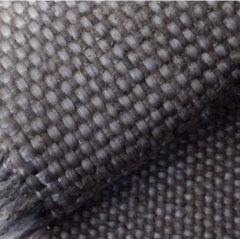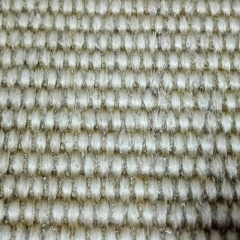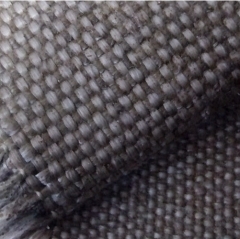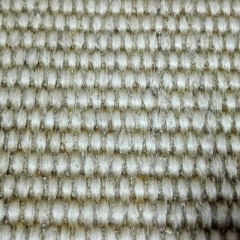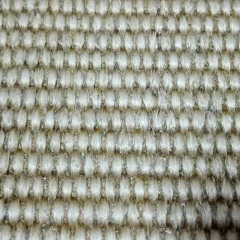
About 2mm Thickness Vermiculite Coated Fiberglass Fabric
2mm Thickness Vermiculite Coated Fiberglass Fabric
A specially formulated, fine vermiculite dispersion that encapsulate the glass fibers and greatly increases resistance to abrasion and temperature. In tests, glass fabric coated with vermiculite has retained its integrity after exposure to a propane blowtorch for short period at temperatures of 2000degree F/ 1093degree C. However the fabric does become brittle locally after exposure to these extreme temperatures and are not recommended for applications where flexibility is important at high temperatures.
Properties:
Vermiculite improve the abrasion resistance and higher temperature performance.
It's tough, durable and resist metal splash and welding spatter
Used at 1500degree F/ 815degree C continuous
Capable of withstanding temperatures of 2000degree F/ 1093degree Cfor short periods
Applications:
Welding spark protection blankets/ curtains, plumbers pads
Insulation mattress/jacket cover material
High temperature fabric seals
Fire protection
Exceptional High-Temperature EnduranceWith a specially formulated vermiculite coating on both sides, this fiberglass fabric withstands continuous temperatures of 1500F (815C) and can tolerate peaks up to 2000F (1093C) for brief periods. Such resilience makes it a reliable choice for challenging industrial and commercial settings requiring dependable fire and high-heat protection.
Versatile Industrial ApplicationsThe fabric's robust construction, 2mm thickness, and superior weight of 1350 GSM allow it to perform efficiently as welding spark protection blankets, curtains, insulation mattress covers, and fire barriers. Its versatility extends to being used by plumbers for pad protection and in the making of high-temperature seals. The product ensures both safety and longevity in operational use.
FAQ's of 2mm Thickness Vermiculite Coated Fiberglass Fabric:
Q: How is the 2mm vermiculite coated fiberglass fabric manufactured?
A: This fabric is produced by applying a specially formulated, fine vermiculite dispersion onto both sides of a glass fiber base. This encapsulation process enhances temperature resistance and durability, making the material suitable for demanding thermal protection applications.
Q: What are the main benefits of using this fabric in high-temperature environments?
A: The main advantages include its excellent ability to withstand continuous heat up to 1500F (815C), brief exposure to 2000F (1093C), and enhanced resistance to thermal shock. The vermiculite coating adds abrasion resistance and reduces fraying, offering extended service life under intense conditions.
Q: When should this vermiculite coated fiberglass fabric be used over uncoated fiberglass cloth?
A: This fabric is recommended when protection against higher temperatures, sparks, and molten metal splashes is required, such as during welding, cutting, or as insulation covers in fire-prone areas. Its double-sided vermiculite coating provides superior performance compared to uncoated options.
Q: Where is this high-temperature fabric commonly applied?
A: It is widely used in industrial facilities as welding blankets, spark curtains, plumbers pads, insulation mattress or jacket covers, high-temperature fabric seals, and fire barriers. It is ideal for environments that demand robust fire and heat protection solutions.
Q: How do I select the appropriate width and length for my project?
A: Choose from the available widths of 1 meter or 1.5 meters based on the coverage area required. Each roll comes in lengths up to 50 meters. Assess your project's dimensions to select the optimal size, ensuring sufficient overlap for effective protection and insulation.
Q: What is the correct process for installing the fabric as a fire barrier or insulation cover?
A: Ensure the surface is clean and measure the required length and width. Cut the fabric with appropriate protective gear, secure it in place using fire-resistant fasteners, and overlap edges as needed for full coverage. Regular inspection and maintenance are recommended in high-activity zones.