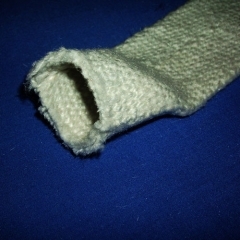
About Ceramic Fiber Braided Sleeve
Ceramic Fiber Braided Sleeve
Produced from an extremely pure alumina-silicate ceramic fiber. Available with fiberglass yarn reinforcement or Steel wire reinforcement.
An alternative to asbestos based rope. Highly flexible and minimal shrinkage
Provides low thermal conductivity and good dielectric strength and features excellent corrosion resistance.Used at 2300 deg F/1260 deg C continuously, molts above 3000 deg F/1650 deg C
Common applications for this sleeve include asbestos sleeve replacement, high temperature resistant electrical cable, wire covering, high temperature pipe wrapping.
Specification
| 2300 deg F/1260 deg C: Ceramic Fiber Braided Sleeve |
| Diameter(mm) | Wall Thickness (mm) | Weight (g/m) | Length (m) |
| 12 | 2 | 50 | 25 |
| 20 | 2 | 72 | 25 |
| 25 | 2 | 90 | 25 |
| 30 | 2 | 105 | 25 |
| 32 | 2 | 115 | 25 |
| 35 | 2 | 122 | 25 |
| 40 | 2 | 148 | 25 |
| 45 | 2 | 154 | 25 |
| 50 | 2 | 170 | 25 |
Superior Fire and Chemical ResistanceThis ceramic fiber braided sleeve delivers exceptional fire resistance, remaining non-combustible even in direct flame exposure. Its resilience against most chemicals (except hydrofluoric and phosphoric acids) makes it suited for harsh industrial settings. The sleeve ensures your cables and pipes are afforded unrivaled protection, which contributes to longer service life and lower maintenance demands.
Customizable for Diverse Industrial ApplicationsAvailable in various diameters and thicknesses, with the option for glass or steel wire reinforcement, this sleeve can be tailored to accommodate unique operational requirements. Use it confidently in furnace, boiler, kiln insulation, metallurgy, foundry, and fire protection contexts. With both ASTM C892 and IS standard compliance, you can trust its safety and performance credentials.
FAQ's of Ceramic Fiber Braided Sleeve:
Q: How is the Ceramic Fiber Braided Sleeve installed for cable and pipe protection?
A: Installation involves sliding or wrapping the sleeve over the cable, hose, or pipe. Its flexible design and good bendability make it easy to apply in tight or irregular spaces, ensuring comprehensive thermal insulation.
Q: What industries benefit most from using this ceramic fiber sleeve?
A: Industries such as metallurgy, foundries, furnace and boiler operations, and fire protection rely heavily on this sleeve for its high-temperature resistance and superior insulation properties. It also sees widespread use in export, distribution, and manufacturing sectors.
Q: What customization options are available for length, thickness, and diameter?
A: Standard rolls are typically 25 meters, but the length, diameter, and thickness (ranging from 3 mm to 10 mm) can be customized according to client requirements. Reinforcement with glass or steel wire is also available upon request.
Q: Where is this braided sleeve commonly applied in high-temperature environments?
A: It is used on electrical cables, hoses, and pipes found in furnaces, boilers, kilns, and within foundry and metallurgy facilities where thermal and fire protection is crucial.
Q: What process is the sleeve manufactured using, and what is its surface treatment?
A: The sleeve is produced using a braided technique, which provides robust structure and flexibility. It features an uncoated surface, preserving its natural insulation and chemical resistance capabilities.
Q: What are the main benefits of using a ceramic fiber braided sleeve over other insulation materials?
A: Key advantages include its extreme fire resistance, excellent electrical insulation, minimal water absorption, and resilience against most chemicals. These features lead to improved safety and reliability in high-temperature applications.
Q: When should you consider using ceramic fiber sleeves with glass or steel wire reinforcement?
A: You should opt for additional reinforcement when extra mechanical strength is needed, such as in environments with high vibration or mechanical wear, to enhance durability and extend the product's service life.