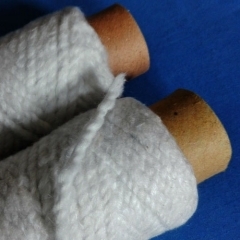
About Ceramic Fiber Yarn
Ceramic Fiber Yarn
Produced from an extremely pure alumina-silicate ceramic fiber. Available with fiberglass yarn reinforcement or Steel wire reinforcement
An alternative to asbestos based rope.Highly flexible and minimal shrinkage
Provides low thermal conductivity and good dielectric strength and features excellent corrosion resistance
Used at 2300 degF/1260 deg C continuously, molts above 3000 deg F/1650 deg C
Common applications for this yarn include high temperature sealing, producing ceramic fiber fabric, tape, rope or sleeve.
Specification
| 300 deg F/1260 deg C:Ceramic Fiber Yarn |
| Part number | TEX | Roll weight (kg) | Reinforcement |
| WCY525G | 525x2 | 1.25 | Glass |
| WCY525S | 525x2 | 1.25 | Stainless steel wire |
| WCY700G | 700x2 | 1.25 | Glass |
| WCY700S | 700x2 | 1.25 | Stainless steel wire |
| WCY1000G | 1000x2 | 1.25 | Glass |
| WCY1000S | 1000x2 | 1.25 | Stainless steel wire |
High-Temperature Insulation SolutionsCeramic Fiber Yarn is designed to meet the stringent demands of high-temperature environments, making it ideal for insulation sealing applications in industries such as metallurgy, power generation, and petrochemicals. The anti-fray coating ensures the yarn remains intact when subjected to handling or operational stress, maximizing service life and efficiency in extreme thermal conditions.
Customizable Dimensions for Versatile ApplicationsOffered in customizable lengths, widths, and thicknesses, this yarn caters to a wide range of installation requirements. The flexibility in sizing allows engineers and maintenance teams to specify exactly what they need, ensuring a precise solution for sealing, thermal insulation, and high-performance gasketing tasks.
FAQ's of Ceramic Fiber Yarn:
Q: How is Ceramic Fiber Yarn with Anti-Fray Coating manufactured?
A: This yarn is produced using a twisting fiber knitting technique that tightly weaves high-purity alumino-silicate fibers. An anti-fray coating is then applied to reduce shedding and increase resistance during high-temperature applications.
Q: What are the main benefits of using alumino-silicate-based ceramic fiber yarn?
A: Alumino-silicate fibers ensure excellent thermal stability, low thermal conductivity, and superior resistance to chemical attacks. The anti-fray surface treatment further extends the yarn's lifecycle in challenging industrial environments.
Q: When should I use Ceramic Fiber Yarn for insulation sealing?
A: This yarn is suitable whenever high-temperature insulation or sealing is needed, especially in environments above conventional fiber limits, such as furnaces, kilns, and piping systems in industrial settings.
Q: Where is this product typically applied?
A: Ceramic Fiber Yarn is widely used in industries including steel, power generation, petrochemicals, and glass manufacturing, primarily as a sealing or insulating material for equipment operating at elevated temperatures.
Q: What process should be followed for installing Ceramic Fiber Yarn?
A: During installation, the yarn can be cut into desired lengths and woven, wrapped, or braided as necessary. The anti-fray coating allows for easy handling without significant fiber loss, and the yarn integrates seamlessly with other refractory materials.
Q: How does the yarn's low thermal conductivity affect its performance?
A: Low thermal conductivity helps minimize heat loss across insulation barriers, making the yarn highly effective in maintaining temperatures and boosting energy efficiency in industrial applications.
Q: What flexibility is there in ordering Ceramic Fiber Yarn from your company?
A: As a China-based distributor, exporter, manufacturer, supplier, and trader, we offer customizable options for length, width, and thickness, and can collaborate to tailor our products to your specific application needs.