About Fiberglass Knitted Rope
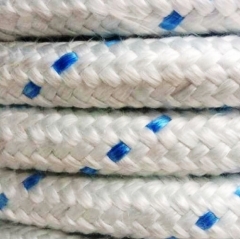
Fiberglass Knitted Rope
Produced of bulk texturized fiberglass yarns, traps greater amounts of air and demonstrates better insulation properties and greater fullness.
Property:
An alternative to asbestos based textiles
It will not burn, rot, mildew or deteriorate and resist most acids.
It has low coefficient of thermal expansion
Used at 1000 degree F / 537 degree C continuous, melts above 1500 degree F / 815 degree C
Available with specialty coatings, such as Dyeing, Graphite, Silicone rubber, Vermiculite, etc.
Common applications including
Used as a gasket or seal on boiler, coke oven, industrial oven and wood stove/pellet stove doors.It is also used for crucible packing and pollution control equipment, pump shaft packing
Exceptional High-Temperature ResistanceFiberglass Knitted Rope maintains structural integrity at temperatures up to 1000F (537C) and only melts beyond 1500F (815C). This exceptional heat resistance makes it indispensable for high-temperature sealing and insulation in demanding industrial environments.
Versatile Industrial ApplicationsThis rope serves as an effective gasket or seal for boilers, ovens, and stove doors. Additionally, it is widely used for crucible packing, pump shaft packing, and various components in pollution control equipment, catering to both heavy and light industrial needs.
Customizable & Durable ConstructionManufactured using elastic knitted techniques, the rope is available in diameters from 4mm to 25mm. Clients can choose from a range of specialty surface treatments, including dyeing, graphite, silicone rubber, and vermiculite, to enhance durability and suitability for specific environments.
FAQ's of Fiberglass Knitted Rope:
Q: How is fiberglass knitted rope typically installed in industrial applications?
A: Fiberglass knitted rope is generally installed by pressing or laying it into grooves or gaps to form an effective seal or gasket, particularly on doors and access panels of boilers, ovens, and stoves. Its elastic nature ensures a tight and dependable fit.
Q: What are the benefits of using this rope as a gasket or seal in high-temperature settings?
A: The rope offers outstanding thermal resistance, maintaining performance at 1000F (537C) continuously. Its durability and flexibility help prevent gas or heat leaks, improving safety and energy efficiency.
Q: When should specialty coatings like graphite or silicone rubber be selected?
A: Specialty coatings should be chosen based on application requirements. Graphite enhances thermal stability and chemical resistance, while silicone rubber improves flexibility and weatherproofing, allowing users to tailor the rope to specific environments.
Q: Where can fiberglass knitted rope be used beyond sealing oven and stove doors?
A: Aside from sealing, this rope is also used for crucible packing, pump shaft packing, and in pollution control equipment, making it suitable for various industrial and engineering applications requiring reliable insulation and sealing.
Q: What is the typical process for manufacturing fiberglass knitted rope?
A: The rope is manufactured by knitting texturized fiberglass yarns using elastic techniques. These can later be treated with specialty coatings such as dyeing, graphite, or vermiculite, ensuring strength and adaptability for different uses.
Q: How does the rope's diameter range benefit industrial users?
A: With options spanning from 4mm to 25mm in diameter, users can select the precise size needed for their application, ensuring optimal sealing efficacy and compatibility with various equipment.
 English
 Spanish
 French
 German
 Italian
 Chinese (Simplified)
 Japanese
 Korean
 Arabic
 Portuguese
 +8613524603686


 Send Inquiry




 Send Inquiry


 Send Inquiry


