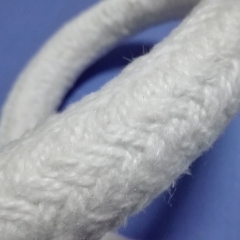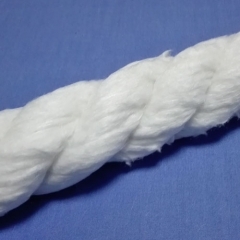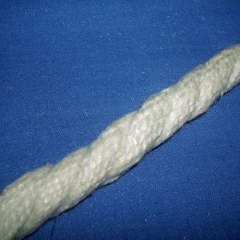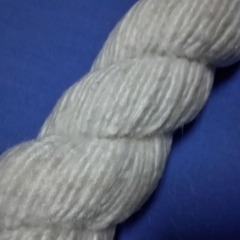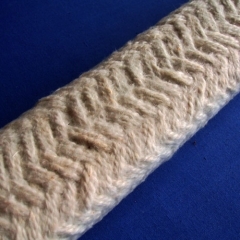
About Ceramic Fiber Round Braided Rope
Ceramic Fiber Round Braided Rope
Produced from an extremely pure alumina-silicate ceramic fiber. Available with fiberglass yarn reinforcement or Steel wire reinforcement
An alternative to asbestos based rope. Highly flexible and minimal shrinkage
Provides low thermal conductivity and good dielectric strength and features excellent corrosion resistance.Used at 2300 degree F/1260 degree C continuously, molts above 3000 degree F/1650 degree C
Common applications for this rope include asbestos packing replacement, radiant tube packing for heat-treat furnaces, expansion joint packing for furnaces, seals for stoves and ovens, bulb in tadpole gasket and door seal insulation
| 2300 deg F / 1260 deg C: Ceramic Fiber Round Braided Rope |
| Diameter (mm) | Roll length (m) | Weight (g/m) | Diameter (mm) | Roll length (m) | Weight (g/m) |
| 5 | 200 | 17 | 18 | 30 | 170 |
| 6 | 100 | 25 | 20 | 30 | 200 |
| 8 | 40 | 25 | 30 | 330 |
| 10 | 60 | 30 | 20 | 420 |
| 12 | 50 | 85 | 35 | 15 | 550 |
| 14 | 110 | 60 | 15 | 1500 |
| 15 | 40 | 130 | 100 | 10 | 4000 |
| 16 | 150 | 120 | 10 | 5650 |
We can braid the size to Dia.130mm.
Exceptional High-Temperature ResistanceThis ceramic fiber braided rope is engineered to perform at temperatures up to 1260C (2300F), making it suitable for the harshest thermal insulation and sealing applications. Its robust construction ensures minimal shrinkage and sustained performance over prolonged exposure to heat.
Versatile ApplicationsThe rope's adaptability allows it to be used in a wide range of industrial settings-including as gaskets, seals for furnace doors, pipe insulation, and packing for expansion joints. Its flexibility and customizable diameters enable tailored solutions for both simple and complex requirements.
Safe and Environmentally Friendly SolutionFree from asbestos, non-toxic, and odorless, the ceramic fiber braided rope prioritizes user safety and environmental standards while maintaining outstanding thermal and mechanical properties. Its construction ensures safe handling and long-term durability in rigorous conditions.
FAQ's of Ceramic Fiber Round Braided Rope:
Q: How is the ceramic fiber round braided rope typically used in industrial applications?
A: This rope is commonly used for thermal insulation, sealing high-temperature doors in furnaces and ovens, gasketing for boilers, packing expansion joints, and pipe insulation. Its flexibility makes it suitable for numerous thermal protection and sealing needs in various industrial sectors.
Q: What are the main benefits of using this ceramic fiber rope compared to traditional alternatives?
A: Unlike traditional asbestos-based materials, this rope is completely asbestos-free, non-toxic, and odorless, making it safer for both workers and the environment. It also offers excellent flexibility and high tensile strength-especially with glass filament or stainless steel wire reinforcement-while maintaining outstanding resistance to extreme temperatures.
Q: When should reinforcement with glass filament or stainless steel wire be selected?
A: Reinforcement with glass filament or stainless steel wire should be chosen when enhanced tensile strength or mechanical stability is required. Applications involving higher stress, tension, or movement benefit from added reinforcement to ensure the rope's integrity during operation.
Q: Where can custom sizes and packaging be requested for the ceramic fiber rope?
A: Custom diameters (typically from 6mm to 50mm) and packaging options such as coils, cartons, or as specified, are available directly from manufacturers, suppliers, and distributors. Requirements can be tailored as per client specifications for different industrial projects.
Q: What is the process of installing this braided rope in furnace or boiler doors?
A: Installation involves cutting the ceramic fiber rope to the required length and placing it into the door or seam that requires high-temperature sealing. The rope's flexibility ensures a snug fit, and no additional surface coating is needed. It is then secured mechanically or with suitable adhesives as per the application.
Q: How does the rope's performance change at elevated temperatures?
A: The rope retains excellent flexibility and does not shrink more than 4% at 1000C, thus maintaining a reliable seal. Its thermal conductivity remains low (0.13-0.16 W/m.K at 600C), ensuring efficient insulation even during repeated thermal cycling.