About Ceramic Fiber Lagging Rope
Ceramic Fiber Lagging Rope
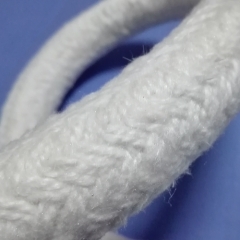
Produced from an extremely pure alumina-silicate ceramic fiber core, ceramic yarn with steel wire reinforced mesh over braided
An alternative to asbestos based rope. Highly flexible and minimal shrinkage
Provides low thermal conductivity and good dielectric strength and features excellent corrosion resistance
Used at 2300 deg F/1260 deg C continuously, molts above 3000 deg F/1650 deg C
Common applications for this rope include asbestos packing replacement, thermal insulation and sealing for stove, burner, chimney door sealing, heat exchanger and kiln car.
Specification
| 2300 deg F/1260 deg C: Ceramic Fiber Lagging Rope with CGI
Ceramic yarn mesh over braided and ceramic fiber core interior |
| Diameter(mm) | Length(m) | Weight(g/m) | Specified |
| 12 | 30 | 85 | mesh |
| 20 | 30 | 160 | mesh |
| 25 | 30 | 235 | mesh |
| 40 | 30 | 565 | mesh |
Superior Heat and Fire ProtectionOur ceramic fiber lagging rope is engineered for demanding applications, providing robust thermal insulation and fire protection up to 1260C (2300F). Its low thermal conductivity ensures efficient heat containment while remaining non-combustible, making it a reliable choice for industrial and commercial environments.
Flexible and Customizable SolutionsAvailable in diameters from 6 mm to 50 mm and customizable lengths, this rope is adaptable for pipe lagging, vessel insulation, kiln sealing, and more. The braided or twisted construction delivers high tensile strength tailored to your specific application needs.
Reliable Performance in Harsh EnvironmentsResistant to most chemicals (except hydrofluoric and phosphoric acids) and offering excellent moisture tolerance, our ceramic fiber rope is suitable for diverse industrial uses. With minimal organic binder and an odorless profile, it maintains integrity and safety, even under extreme conditions.
FAQ's of Ceramic Fiber Lagging Rope:
Q: How is Ceramic Fiber Lagging Rope typically used in industrial applications?
A: Ceramic Fiber Lagging Rope is primarily used for thermal insulation in piping, vessels, and furnaces. It also serves as gasketing, expansion joint packing, and kiln door sealing due to its high temperature resistance and flexibility.
Q: What benefits does this rope offer over other insulation materials?
A: This ceramic fiber rope provides non-combustibility, high tensile strength, resistance to most chemicals, excellent moisture resistance, and superior performance at elevated temperatures up to 1260C, surpassing many conventional insulation solutions.
Q: When should I use ceramic fiber rope instead of glass fiber or mineral wool insulation?
A: Choose ceramic fiber rope for applications where temperatures exceed the service capabilities of glass fiber or mineral wool, or when non-combustibility and chemical resistance (excluding hydrofluoric and phosphoric acids) are required.
Q: Where can I install this braided or twisted fiber rope?
A: It can be installed in any location demanding durable thermal insulation and fire protection, such as around pipes, flanges, vessel joints, furnaces, kilns, and expansion joints in both industrial and commercial settings.
Q: What is the manufacturing process for this lagging rope?
A: The rope is fabricated by braiding or twisting high purity alumino-silicate ceramic fiber yarns. This process results in a dense, flexible rope with high tensile strength and minimal organic binder content.
Q: How does the chemical resistance of ceramic fiber rope compare to other materials?
A: Ceramic fiber rope is resistant to most chemicals, except hydrofluoric and phosphoric acids. Its alumino-silicate composition provides reliable stability in harsh chemical and high-temperature environments.
Q: What packaging options are available for this product?
A: Ceramic Fiber Lagging Rope is supplied either in coils or mounted on reels, with dimension options customizable to match your specific length and diameter requirements.

 English
 Spanish
 French
 German
 Italian
 Chinese (Simplified)
 Japanese
 Korean
 Arabic
 Portuguese
 +8613524603686


 Send Inquiry




 Send Inquiry


 Send Inquiry


