About Aluminized Ceramic Fiber Fabric
Aluminized Ceramic Fiber Fabric
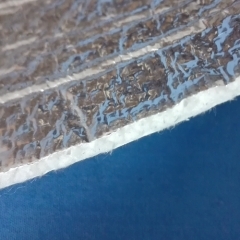
Aluminium foil laminated on one side for reflective heat shield. Produced from an extremely pure alumina-silicate ceramic fiber
Available with fiberglass yarn reinforcement or Steel wire reinforcement. An alternative to asbestos based textiles
Provides low thermal conductivity and good dielectric strength and features excellent corrosion resistance
Used at 2300 degree F/1260 degree C continuously, molts above 3000 degree F/1650 degree C
It will not burn, rot, mildew or deteriorate and resist most acids. It has low coefficient of thermal expansion, used in applications including welding blankets, stress relieving, removable insulation covers, fire blankets, fire curtains, expansion joints and flue ducts.
|
2300 degree F/1260 degree C: Aluminized ceramic Fiber Fabric
|
|
Part number
|
Roll size
|
Weight (kg/roll)
|
Reinforcement
|
|
WCF115 A
|
1.5mmX1mX30m
|
24kg
|
Glass
|
|
WCF215A
|
26kg
|
Steel
|
|
WCF120A
|
2.0mmX1mX30m
|
30kg
|
Glass
|
|
WCF220A
|
33kg
|
Steel
|
|
WCF130A
|
3.0mmX1mX30m
|
42kg
|
Glass
|
|
WCF230A
|
45kg
|
Steel
|
Superior High-Temperature ResistanceThis ceramic fiber fabric maintains its structure and insulation capabilities under extreme heat, continuously withstanding up to 2300F (1260C) and briefly tolerating even higher molten metal contact. Its aluminized surface further enhances heat shielding by reflecting radiant energy, making it ideal for intense industrial environments such as welding stations and furnaces.
Versatile Industrial ApplicationAluminized Ceramic Fiber Fabric finds extensive use across multiple industries. It serves reliably as welding blankets, fire curtains, insulation covers, and expansion joint materials, ensuring worker and equipment safety in high-temperature operations. Its adherence to non-asbestos standards promotes a safer workspace without compromising performance.
FAQ's of Aluminized Ceramic Fiber Fabric:
Q: How is Aluminized Ceramic Fiber Fabric used in high-temperature environments?
A: The fabric is employed wherever robust thermal protection is needed, such as in welding blankets, fire curtains, and removable insulation covers. It acts as a barrier to radiant and convective heat, protecting personnel and equipment from heat-related hazards.
Q: What makes this fabric an effective alternative to asbestos-based textiles?
A: It is made from highly pure alumina-silicate ceramic fibers, offering similar or superior thermal insulation without the health risks associated with asbestos. Its durability, high-temperature resistance, and option for reinforcement provide a safer and more efficient solution.
Q: When should you consider using adhesive-backed or reinforced versions of the fabric?
A: Adhesive-backed fabric is preferable for installations requiring easy placement or attachment. Reinforced versions, using fiberglass yarn or steel wire, are suited for applications demanding higher strength and prolonged durability under mechanical stress.
Q: Where is this aluminized ceramic fiber fabric most commonly applied?
A: It's widely used in industries like metalworking, power generation, and chemical plants, particularly in applications like stress relieving, flue duct insulation, fire protection barriers, and expansion joints.
Q: What is the process for installing this ceramic fiber fabric as a heat shield?
A: Installation involves cutting the fabric to the required dimensions and placing it with the aluminized or adhesive side facing the heat source. Fastening methods vary from mechanical fixing to using the adhesive backing for efficient placement.
Q: What are the main benefits of choosing this specific product?
A: The key advantages include outstanding thermal resistance, enhanced reflectivity due to the aluminized foil, asbestos-free safety, mechanical reinforcement options, and suitability for a wide array of industrial safety and insulation needs.
 English
 Spanish
 French
 German
 Italian
 Chinese (Simplified)
 Japanese
 Korean
 Arabic
 Portuguese
 +8613524603686


 Send Inquiry


 Send Inquiry


 Send Inquiry


