About Texturized Basalt Fiber Fabric
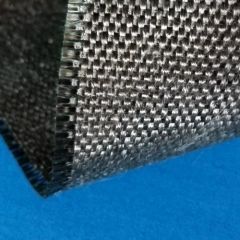
Texturized Basalt Fiber Fabric
- Produced of bulk texturized basalt yarns, traps greater amounts of air and demonstrates better insulation properties and greater fullness
- Good rot and mildew resistance and tensile strength
- An alternative to asbestos and ceramic based textiles
- A high-performance very high temperature fabric, used in almost all industries for heat protection
- Used at 1200 degree F / 648 dgree C continuous, maintains integrity at temperatures up to 1800 degree F / 982 degree C
Available with specialty coatings such as Aluminium foil, Wire insert, etc.
Common applications including:Heat shields, welding curtains, stress relieving, removable insulation covers, fire blankets, fire curtains, expansion joints and flue ducts.
Specification 1200 degree F / 648 degree C: Texturized Basalt Fiber Fabric | Part number | WBF208 | WBF210 | WBF215 | WBF220 | WBF225 | WBF230 |
| Weave | Plain | Plain | Plain | Plain | Plain | Plain |
| Weight (g/ m2) | 710 50 | 880 60 | 1100 70 | 1430 85 | 1760 100 | 1980 110 |
| Width (mm) | 1000mm-2000mm |
| Thickness (mm) | 0.8 0.08 | 1.0 0.10 | 1.5 0.15 | 2.0 0.2 | 2.5 0.25 | 3.0 0.30 |
| Roll length (m) | 50 1 | 50 1 | 50 1 | 30 1 | 30 1 | 30 1 |
Superior Thermal and Fire ProtectionThanks to its high melting point (around 1450C) and continuous heat endurance up to 750C, texturized basalt fiber fabric delivers reliable fire and thermal insulation. Its non-combustible, durable structure ensures lasting protection in welding blankets, furnace curtains, and heat shields.
Environmental Responsibility and SafetyMade from natural basalt fibers, this fabric is non-toxic, recyclable, and eco-friendly. It does not contain hazardous materials, offering a safe solution for diverse industrial and commercial uses. Its resistance to acids, alkalis, and moisture further boosts longevity and minimal environmental impact.
Customized Versatility for ApplicationsAvailable in multiple thicknesses (0.5 mm to 3 mm), GSM ranges, weave styles, and dimensions, the fabric adapts to various requirements. Whether for automotive components, marine equipment, cable protection, or expansion joints, manufacturers, suppliers, and distributors can provide tailored solutions from China.
FAQ's of Texturized Basalt Fiber Fabric:
Q: How is texturized basalt fiber fabric manufactured?
A: The fabric is produced using a texturized weaving technique, where continuous basalt fibers are woven into plain or twill patterns. The surface is heat-cleaned to remove impurities, enhancing performance and durability.
Q: What benefits does basalt fiber fabric provide for thermal insulation and fire protection?
A: Basalt fiber fabric's low thermal conductivity, non-combustibility, and high melting point make it exceptional for thermal insulation and fire protection, protecting equipment and personnel up to 750C continuously and 1000C at peak.
Q: When should texturized basalt fiber fabric be used over traditional materials?
A: It is preferable in applications requiring superior heat resistance, abrasion resistance, and environmental safety, such as welding blankets, furnace curtains, and cable protection, where conventional fabrics may degrade or combust.
Q: Where can this fabric be applied for industrial solutions?
A: This material is suitable for automotive, marine, and industrial sectors, especially in thermal insulation, fire protection, filament filtration, and as protective coverings for cables and expansion joints.
Q: What is the process for customizing basalt fiber fabric dimensions and thickness?
A: Manufacturers and suppliers offer the fabric in rolls or sheets, with tailored width, length, thickness (0.5 mm to 3 mm), and GSM (270-980) to meet specific customer needs. Coating options are also available upon request.
Q: How does basalt fiber fabric contribute to environmental sustainability?
A: Basalt fiber is derived from natural volcanic rock, making the fabric non-toxic, recyclable, and eco-friendly. It resists chemicals and environmental degradation, promoting a sustainable approach in industries.
 English
 Spanish
 French
 German
 Italian
 Chinese (Simplified)
 Japanese
 Korean
 Arabic
 Portuguese
 +8613524603686

 Send Inquiry


 Send Inquiry


 Send Inquiry


