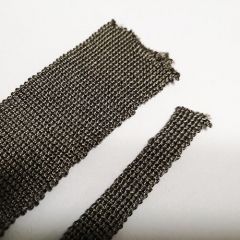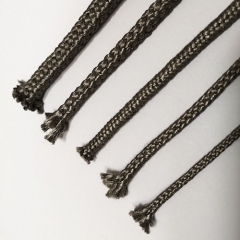
About Stainless steel fiber knitted fabric
Knitted from 100% SUS 316L stainless steel fiber ( not stainless steel wire).Combine heat resistance and mechanical durability with the softness of a textile fabric.Smooth surface
Used as mold separator and formed cushioning material for the automotive glass, glass bottles and CRT (TV) glass.Improve the smooth appearance of glassl Used at 1200 deg F/648 deg C continuously, Molten at 2500 deg F/1371 deg C.Other application required high temperature resistant together with friction resistant and electric conductivity.
1200 deg F/648 deg C continuous rating, excellent mold separator and formed cushioning material for the automotive glass
| Chemical Composition of Raw Materials (%) |
| SUS 316L | C | Si | Mn | Ni | Cr | Mo | N | S | P |
| 0.02 | 0.60 | 0.82 | 11.1 | 16.9 | 2.04 | 0.03 | 0.0005 | 0.027 |
Advanced Performance FabricDesigned for demanding environments, this stainless steel fiber knitted fabric is engineered to deliver impressive elongation (20-30%) and superior corrosion resistance. Its high flexibility, alongside low electrical and negligible water absorption properties, guarantee robust functionality for a variety of critical uses.
Versatile Industrial ApplicationsThanks to its adaptable structure and customizable sizing, this fabric is trusted across sectors including electronics (EMI shielding), safety (anti-static garments), healthcare (medical textiles), and heavy industry (filtration and heating solutions). The combination of high thermal conductivity and non-flammable characteristics makes it indispensable in challenging conditions.
Custom Solutions and Reliable SupplyAs a direct manufacturer, exporter, and distributor based in China, we offer OEM services and can tailor width, length, and fabric style to your project's exact requirements. Proper storage ensures an unlimited shelf life, making it a sound investment for bulk and recurrent needs.
FAQ's of Stainless steel fiber knitted fabric:
Q: How should stainless steel fiber knitted fabric be stored to maintain its quality?
A: Store the fabric in a dry, well-ventilated area away from moisture and corrosive agents. Under these proper storage conditions, the shelf life is unlimited, ensuring the fabric's performance is preserved over time.
Q: What applications benefit most from this stainless steel knitted fabric?
A: The fabric is highly effective in EMI shielding, anti-static garments, medical textiles, industrial filtration, and as sensors or heating elements due to its conductivity, corrosion resistance, and ability to withstand high temperatures.
Q: When is it advisable to use Grade 316L vs. 304 stainless steel for this fabric?
A: Grade 316L is often chosen for applications requiring superior corrosion resistance, such as medical or marine environments, whereas 304 is typically used for general industrial or anti-static purposes. The selection depends on the specific exposure and performance requirements.
Q: Where is the fabric manufactured and can it be shipped internationally?
A: Our stainless steel fiber knitted fabric is manufactured in China and is available for global distribution. We support orders from distributors, exporters, and direct industrial users worldwide.
Q: What is the process for customizing the fabric size or style to meet project requirements?
A: We offer OEM services to tailor the width (from 105 cm to 150 cm), length, style (plain or ribbed), and other specifications. Customers can provide their exact requirements, and our team will deliver according to those custom parameters.
Q: How does the fabric's knitted structure impact its usage and benefits?
A: The knitted weave enhances flexibility, strength, and stretch (20-30% elongation at break), making it suitable for applications where adaptability and durability are crucial, such as wearable technologies and flexible filters.
Q: What are the key benefits of using this stainless steel fiber knitted fabric in industrial applications?
A: Key benefits include excellent corrosion and flame resistance, high durability, effective EMI shielding, thermal conductivity, low electrical resistance, and adaptability for custom solutions-making it a versatile, long-lasting raw material for modern industries.