About Fiberglass Sleeve
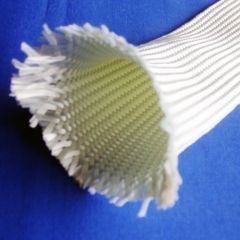
Fiberglass Sleeve
Produced of filament fiberglass yarns, and is not texturized yarns, resulting in a sleeve that is extremely smooth and clean of loose fibers. Made by a tubular braiding to obtain a extremely elastic and flexible sleeve.
Property:
Resists most acids and alkalis and is unaffected by most bleaches and solvents. It is highly flexible and conformable.
Used at 1000 degree F / 537 degree C continuous, If exposed to high temperature 600 degree F (315 degree C) to 1000 degree F (537 degree C) for an extended period of time the sleeve may become stiff and brittle.
Available with specialty coatings such as Heat treatment, Acrylic, Silicone rubber, Silicone resin, PVC, Dyeing, etc.
Applications:
Used to protect wires, cables, hoses, piping and tubing from high temperatures.
Specificaiton
| 1000 degree F / 537 degree C: Filament Fiberglass Braided Sleeve |
| Part number | Diameter
(mm) | Tolerance
(mm) | Wall thickness(mm) | Tolerance
(mm) | Length
(m) |
| WFS1005 | 0.5-3.5 | +0.3/-0 | 0.20 | +/-0.05 | 200 |
| WFS1040 | 4 -6 | +0.3/-0 | 0.30 | +/-0.05 | 100 |
| WFS1070 | 7-10 | +0.3/-0 | 0.40 | +/-0.05 | 100 |
| WFS1120 | 12-16 | +0.5/-0 | 0.50 | +/-0.05 | 100 |
| WFS1180 | 18-22 | +0.8/-0 | 0.60 | +/-0.05 | 50 |
| WFS1250 | 25-30 | +0.9/-0 | 0.70 | +/-0.05 | 50 |
| WFS1320 | 32-40 | +0.9/-0 | 0.88 | +/-0.05 | 50 |
Thermal Class: Grade C (+550 degree C, -50 degree C)
Breakdown voltage: 500V-800V According to UL 1441
Flame propagation: According to UL VW-1
Exceptional High-Temperature PerformanceOur fiberglass sleeves are engineered to withstand continuous temperatures up to 1000F (537C). This makes them highly suitable for industries where elevated temperatures are a constant concern, ensuring maximum protection for sensitive wires, cables, and hoses.
Versatile Surface Treatments AvailableWe offer a wide range of specialty coatings including heat treatment, acrylic, silicone rubber, silicone resin, PVC, and dyeing. These enhancements improve durability, chemical resistance, and adaptability to diverse industrial applications.
Flexible Design and Adaptable SizesProduced using a tubular braiding technique from filament fiberglass yarns, the sleeve is both elastic and smooth, ensuring easy installation and a clean, fiber-free finish. Diameters range from 1mm to 50mm, catering to various protective needs.
FAQ's of Fiberglass Sleeve:
Q: How does the fiberglass sleeve protect wires and cables in high-temperature environments?
A: The fiberglass sleeve acts as an effective barrier against heat, withstanding continuous temperatures of up to 1000F (537C). Its non-texturized construction results in a smooth sleeve that prevents fraying and fiber loss, shielding wires, cables, and hoses from thermal damage.
Q: What specialty surface treatments are available for the fiberglass sleeves?
A: We offer multiple coatings on our sleeves, such as heat treatment, acrylic, silicone rubber, silicone resin, PVC, and various dyeing options. These treatments enhance performance by increasing resistance to specific environmental hazards like chemicals, abrasion, or moisture.
Q: When should I choose a fiberglass sleeve with a particular coating?
A: Selecting a coating depends on your operational environment. For chemical resistance, silicone rubber is ideal. If you need added flame resistance, a heat-treated sleeve is best. PVC coatings provide weatherproofing, while dyeing differentiates or color-codes specific applications.
Q: Where can these fiberglass sleeves be applied?
A: Our fiberglass sleeves are suitable for a broad range of industries, including electrical, automotive, aerospace, and manufacturing, wherever wires, cables, hoses, or tubes are exposed to high temperatures or hazardous conditions.
Q: What is the process for manufacturing these sleeves?
A: The sleeves are produced by tubular braiding filament fiberglass yarns. This creates an elastic and flexible sleeve without loose fibers, resulting in a neat and durable product that is easy to handle and install.
Q: What are the main benefits of using a non-texturized fiberglass yarn sleeve?
A: Non-texturized yarn ensures the sleeve remains smooth, free from loose fibers, and highly flexible. This makes it a preferred choice for clean applications where dust, stray fibers, or bulkiness could cause issues.

 English
 Spanish
 French
 German
 Italian
 Chinese (Simplified)
 Japanese
 Korean
 Arabic
 Portuguese
 +8613524603686

 Send Inquiry


 Send Inquiry


 Send Inquiry


