About Fiberglass Knitted Wick Rope
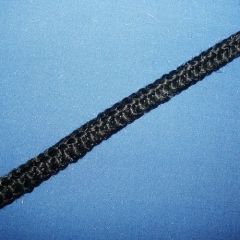
Fiberglass Knitted Wick Rope
Produced of bulk texturized fiberglass yarns, traps greater amounts of air and demonstrates better insulation properties and greater fullness.
Property:
An alternative to asbestos based textiles
It will not burn, rot, mildew or deteriorate and resist most acids.
It has low coefficient of thermal expansion
Used at 1000 degree F / 537 degree C continuous, melts above 1500 degree F / 815 degree C
Available with specialty coatings, such as Dyeing, Graphite, Silicone rubber, Vermiculite, etc.
Common applications including
Used as a gasket or seal on boiler, coke oven, industrial oven and wood stove/pellet stove doors. It is also used for crucible packing and pollution control equipment, pump shaft packing
Enhanced High-Temperature PerformanceDesigned using premium texturized fiberglass yarns, this knitted wick rope maintains structural integrity at elevated temperatures up to 1000F (537C). Specialty coatings, such as graphite and silicone rubber, further enhance its thermal resistance, making it suitable for critical sealing applications across various industries.
Versatile Industrial ApplicationsThis fiberglass rope serves multiple roles-as gaskets, seals, crucible packing, and pump shaft packing. Its adaptability ensures reliable sealing in boilers, ovens, wood stoves, and pollution control equipment, supporting safe and efficient operations in high-temperature environments.
FAQ's of Fiberglass Knitted Wick Rope:
Q: How is the Fiberglass Knitted Wick Rope typically used in industrial applications?
A: It is most commonly used as a gasket or seal on doors of boilers, industrial ovens, coke ovens, and wood or pellet stoves, as well as for crucible and pump shaft packing. The rope effectively contains heat and prevents leakage in these high-temperature settings.
Q: What temperatures can the Fiberglass Knitted Wick Rope withstand during operation?
A: The rope is rated for continuous use at 1000F (537C) and will only begin to melt above 1500F (815C), providing reliable performance in environments with consistent high heat.
Q: When should specialty coatings be selected for the rope, and what options are available?
A: Specialty coatings like dyeing, graphite, silicone rubber, or vermiculite are chosen based on application needs, such as increased thermal barrier, chemical resistance, or enhanced durability. Selection depends on the specific environmental demands and the type of equipment where the rope is being installed.
Q: Where can this fiberglass rope be installed for optimal results?
A: Install the rope in equipment and machinery that operates at high temperatures, such as boiler doors, industrial ovens, and wood or pellet stoves. It is also effective for sealing in crucibles, pump shafts, and pollution control setups, maximizing longevity and reliability.
Q: What is the manufacturing process of the Fiberglass Knitted Wick Rope?
A: The rope is created by knitting high-quality texturized fiberglass yarns around a core, resulting in a flexible structure that accommodates movement while maintaining an effective seal even under varying pressure and temperature conditions.
Q: What are the benefits of using this rope over other sealing materials?
A: This rope offers superior heat tolerance, flexibility, and resistance to abrasion, chemicals, and thermal shock. Its adaptability for various coatings and sizes ensures it meets a wide array of industrial sealing challenges, often lasting longer and performing more reliably than standard gasket materials.
 English
 Spanish
 French
 German
 Italian
 Chinese (Simplified)
 Japanese
 Korean
 Arabic
 Portuguese
 +8613524603686


 Send Inquiry




 Send Inquiry


 Send Inquiry