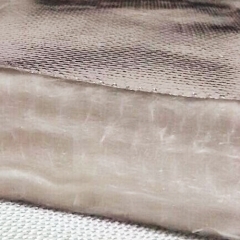
About 800 degree C Fiberglass Needle Mat
800 degree C Fiberglass needle mat uses Eglass fiber roving as the raw materials while each strand is chopped into a 23 inch fraction via the fiber cutting machine and further decomposed into extreme tiny blanket shape through the cotton carding engine Subsequently the needled fabrics are ceaselessly sewn by thousands of needles
Property
It is characterized by heatresistance tensile strength tenacity fireproofing antierosion and good electrical insulation
The adoption of extreme tiny Eglass fiber followed by particular needling leads to numerous thin holes with the fiberglass blanket so as to provide heatinsulation and soundabsorbency
Applications
Subsequent to being dipped into the resin and next processed into lath shapes the fiberglass blanket is applicable to building construction and gaskets of air conditioners for heat insulation and noise elimination
Subsequent to the laminating for aluminum foil aluminized glass fabric and PVC fabrics on the surface and next being processed into straps it is provided for thermal insulation and protection of cold hot piping and underground pipes
Employed as heatresistant tensile waterproof antierosion materials including heat proofing of engine hoods cars mufflers thermal insulation materials of industrial boiler sand being able to replace expensive fullyimporting asbestos goods
Advanced Thermal and Acoustic InsulationEngineered for performance, this fiberglass needle mat offers exceptional heat and sound insulation. Its dense, needled construction minimizes heat loss and dampens noise, making it an excellent choice for both industrial and residential applications where temperature and sound control matter most.
Robust Protection for Piping and MachineryThe mat's heat-resistant and anti-erosion qualities provide long-lasting protection for both hot and cold pipelines, underground pipes, and high-temperature machinery. Its flexibility and strength, thanks to E-glass fiber composition, ensure durable insulation even in extreme environments.
Versatile Applications Across IndustriesFrom building construction and HVAC gasket fabrication to automotive and industrial sectors, the fiberglass needle mat is widely used for its reliability and safety. Whether insulating engine hoods, car mufflers, or industrial boilers, this product safeguards equipment and structures against heat, fire, and environmental stress.
FAQ's of 800 degree C Fiberglass Needle Mat:
Q: How is the 800C Fiberglass Needle Mat manufactured?
A: This mat is produced by chopping E-glass fiber roving into 2 to 3 inch segments, carding the fibers into a uniform blanket using specialized machinery, and then stitching it ceaselessly with thousands of needles to form a robust, resilient structure.
Q: What are the typical applications for this fiberglass needle mat?
A: It is commonly used for building insulation, air conditioner gaskets, protection of cold and hot piping, underground pipe insulation, engine hood and car muffler heat-proofing, and as a thermal barrier for industrial boilers.
Q: When should I use this needle mat instead of other insulation materials?
A: Opt for the 800C Fiberglass Needle Mat when you require high-temperature resistance, robust tensile strength, and protection against erosion and moisture. It is especially valuable in environments where heat or fire exposure is significant.
Q: Where can the fiberglass needle mat be installed?
A: You can install this mat in various settings, including inside buildings, wrapped around piping, HVAC systems, automotive components, and industrial machinery, anywhere where heat and acoustic insulation or protective barriers are needed.
Q: What process is involved in the surface treatment of the mat?
A: The mat undergoes a ceaseless needling process, where thousands of needles continuously stitch the fibers, enhancing strength and structural integrity without the use of adhesives or additional binders.
Q: How does the mat benefit users in terms of safety and longevity?
A: The mat's high heat resistance (up to 800C), anti-erosion, and waterproof properties ensure long lifespan and enhanced safety for insulated equipment, reducing maintenance costs and minimizing risks associated with heat and fire.

 English
 Spanish
 French
 German
 Italian
 Chinese (Simplified)
 Japanese
 Korean
 Arabic
 Portuguese
 +8613524603686


 Send Inquiry


 Send Inquiry


 Send Inquiry


