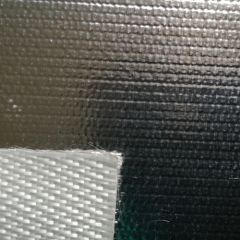
About 0.8mm Aluminium foil laminated fiberglass fabric
Aluminium foil laminated fiberglass fabric is constructed from a high temperature base filament/texturized fiberglass fabric which is then coated with highly reflective polished aluminum foil. The aluminum foil coating melts at 1220degree F/ 660degree C, however it does take some time for the aluminum foil to absorb enough heat to melt,thereby it can withstand short exposure to the higher temperatures. The basic fiberglass fabric is 1000degree F/537degree C, while adhesive will burn-off or vaporize at temperatures above 300degree F/148degree C.Properties:One side coated with Aluminum foil. Protection from intense radiant heatReflects more than 95% of the radiant heat that contacts its surfaceExcellent radiant heat protection from sources such as super-hot metal slabs, proximity to liquid metal, infrared heaters, open flame / plasma or engine exhaust manifolds is a concernApplications:Serve as a welding defender, heat protection quilt, foundry splash protectionConveyor belt and expansion jointChemical corrosion resistance, packing materialUsed for aerospace, marine, chemical industrial, power plant, automotive, construction, pipling flexibility and sealing industry.PSA(pressure sensitive adhesive) AvailableThis fabric is also available with a self-adhesive backing.The adhesive is water adhesive based, and will burn-off or vaporize at temperatures above 300degree F/148degree C.If prolonged use of the self-adhesive fabric above 300degree F/148degree C is desired, then alternate securing methods such as fasteners, wire or clamps should be used.Personnel should avoid inhaling fumes from the PSA.We have a SuperTemp adhesive can work at temperature 280degree C continuously.Superior Multi-Industry Heat ProtectionThis fabric integrates advanced satin-weave fiberglass with highly reflective aluminium foil, delivering outstanding protection against heat, splashes, and chemical corrosion. It is widely deployed in demanding environments-from shipyards to refineries-where both durability and superior insulation are paramount. Its flexibility makes it suitable for expansion joints and conveyor belts, while its safety performance fulfills the rigorous standards of the aerospace and automotive industries.
Engineered for Tough EnvironmentsThanks to its high-temperature resistant base and aluminium foil coating, this material stands up to intense industrial conditions. It's designed not only for exposure to high heat and molten splashes but also to resist chemical attacks, ensuring longevity in chemical plants, power stations, and during welding applications. Its construction promises both mechanical strength and lasting performance.
FAQ's of 0.8mm Aluminium foil laminated fiberglass fabric:
Q: How is the aluminium foil laminated fiberglass fabric manufactured?
A: The fabric is produced by weaving high-temperature filament or texturized fiberglass into a satin weave, after which one side is coated with highly reflective aluminium foil (available in 7, 18, or 25 micron thicknesses). This process enhances heat insulation, durability, and chemical resistance.
Q: What are the primary applications of this fabric?
A: It is used in multiple sectors: aerospace, marine, chemical industry, power plants, automotive manufacturing, construction, and sealing industries. Its roles include welding defenders, heat protection quilts, foundry splash protection, as well as conveyor belt and expansion joint materials.
Q: When should this material be chosen over standard insulation fabrics?
A: This fabric is ideal for scenarios requiring superior heat resistance, splash protection from molten metals, or exposure to chemicals. Its enhanced durability and reflectivity make it preferable in environments where standard fabrics may degrade quickly.
Q: Where can the fabric be installed or applied?
A: It can be installed wherever high-temperature management or chemical resistance is critical-around piping, inside industrial enclosures, on machinery, or as protective barriers in construction zones, shipyards, power stations, or manufacturing plants.
Q: What is the benefit of varying aluminium foil thickness (7, 18, 25 microns)?
A: Different foil thicknesses allow for customization based on heat reflectance and durability needs. Thicker foils (25 microns) offer greater mechanical protection and heat resistance, while thinner options provide flexibility and lighter weight.
Q: How does the fabric function as a welding defender and heat protection quilt?
A: The combination of reflective aluminium and thermal insulation from the fiberglass base forms an effective barrier against radiant and convective heat, making it suitable as a welding defender to shield nearby equipment or as a heat protection quilt for personnel safety.
Q: What is the typical size and weight of the rolls supplied?
A: The fabric is typically supplied in rolls measuring 1 or 1.5 meters in width, 50 meters in length, and weighs 890 GSM, making it easy to handle and cut for various industrial configurations.

 English
 Spanish
 French
 German
 Italian
 Chinese (Simplified)
 Japanese
 Korean
 Arabic
 Portuguese
 +8613524603686


 Send Inquiry



 Send Inquiry


 Send Inquiry


